We Are Still Here. We Are Still Vital. — A New Report from the Kent and Medway RNLD CPD Event

On 17 February 2026, more than thirty-five learning disability nursing professionals from across Kent and Medway gathered for a day of honest, structured conversation about who they are, what their work does, and what needs to change. Over 500 combined years of experience were in the room.

The result is We Are Still Here. We Are Still Vital. — a new report that is ready to read and share.

What it found

Participants were clear. LD nurses see the whole person, identify what others miss, prevent diagnostic overshadowing, and change how entire teams behave. When asked what would be lost without Learning Disability nursing, answers included over-medication, people lost without a voice, earlier deaths, and — from one experienced practitioner — simply: Catastrophic.

Three collective actions

  1. Formalise a Kent and Medway Learning Disability Nursing Network — quarterly, with lived experience representation, linked to the KSS Community of Practice.
  2. Take LD nursing into schools and colleges — outreach into at least five settings within twelve months, co-delivered with lived experience partners.
  3. Build the evidence base — a working group to develop outcome frameworks that capture the preventative impact of Learning Disability nursing.

Read it. Share it. Use it.

The report is written to be placed in front of commissioners, Chief Nurses, and workforce planners. If you’d like to get involved in any of the three collective actions, we’d love to hear from you.

KaM RNLD CPD Report LDNursing April 26

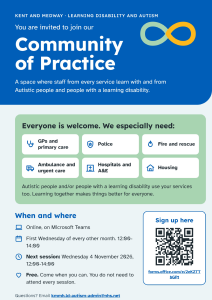
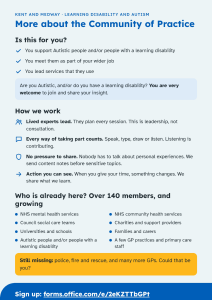
Something New Is Starting — And You’re Invited

Ruth Germaine is launching Co-creation Learning Sessions, and she wants you to know about them.

Whether you have lived experience of learning disabilities or autism, whether you are a family member, or whether you work in services, this is for you.


What Are Co-creation Learning Sessions?

These are sessions where staff learn with and from people with lived experience.

In these sessions:

  • Everyone’s voice matters — not just the professionals
  • We work together to make services better
  • People with learning disabilities, autistic people, families, and staff are all part of the learning

Why Is Ruth Doing This?

Ruth wants to understand what good co-creation really looks like in practice.

Co-creation means working with people — not doing things to people.

It means listening. It means learning. It means sharing ideas together.


When Does It Start?

The sessions will begin in May.

This is a pilot — which means Ruth is trying it out first, to see what works well and what needs to change before making it bigger.


Would You Like to Get Involved?

Ruth is looking for people who might want to:

Join the sessions

Support the sessions

Watch and listen — just to see what it is like

This could be you, or someone you know.

To get involved, contact Ruth directly:

📧 Ruth Germaine ruth.germaine@reflectiveruthconsultancy.com


What Happens After the First Sessions?

After the first few sessions, Ruth will bring people back together to talk about:

  • What we learned
  • What people need next
  • How we can keep improving

A Message From Ruth

“We hope these sessions will be a welcoming space where everyone can learn together — whatever your background or experience. I would love to hear from you.”

💙 Ruth Germaine | ruth.germaine@reflectiveruthconsultancy.com

Safeguarding is everyone’s responsibility!

Introducing this great new video created by Brighton & Hove Speak Out and Grace Eyre, on the importance of speaking up and keeping safe fom exploitation and abuse. Highlighting the different types of abuse experienced, people with learning disabilities talk about the importance of ensuring we all take responsibility to keep people safe. Please share!

#Safeguarding #Keeping Safe

Speaking Up and Keeping Safe – a safeguarding video

Inclusive Talks


Could you or someone you know help with some important research?
UCL want to hear from adults with learning disabilities about their experiences of NHS talking therapies — so services can work better for everyone. 

Participants receive a £75 shopping voucher for taking part!

email – inclusivetalk@ucl.ac.uk or scan QR code in flyer

Check out the information in the flyer below for further details and share if you can! 👇


The Yellow Tulip Group: Researching with people

The Yellow Tulip Group is for anyone who is interested in doing research with people with a learning disability. It is run by Jonny Ding, Richard Keagan-Bull, Andrew Priest and Irene Tuffrey-Wijne who are all members of the Kingston University Intellectual Disability (KIND) research group

Our meetings are open to seasoned researchers, people just starting out, people with a learning disability, family members, carers, students, and practitioners. We’ve even had people join us from different parts of the world. If you’re curious about inclusive research, you’re welcome.

The group has been running for over four years now, and we meet on Zoom on the last Tuesday of every month from 12–1pm. The meetings are informal and friendly. There’s no pressure — you can come along to listen, share, ask questions, or just see what it’s all about.

Our topics are guided by what people in the group want to talk about. Over the past few years, we’ve explored things like:

  • Doing research together with people with a learning disability
  • Creative and fun research methods
  • Publishing research articles together
  • Ethics applications
  • Sharing ongoing projects and learning together

Sometimes we’ve had short presentations. Other times, it’s been more of an open discussion. What matters most is that it’s a collaborative space where people doing inclusive research can learn from each other.

There is so much brilliant research happening, but we don’t always get to hear about it. The Yellow Tulip Group is a space to share ideas, challenges, successes, and good practice. It’s about supporting each other to do research together, not just research on people.

“Keith and I just want to thank you, Irene , Richard and Sarah for the brilliant meeting today! We’d really like Sarah to know how much we enjoyed her presentation and how it inspired Keith in taking forward his own family research… Keith felt that Sarah’s films made history much more accessible for him.” If you’d like to join us, you can email Jonny.Ding@kingston.ac.uk to sign up. We’d love to see you!