NHS England publishes new guidance on community living for autistic people and people with a learning disability.

Published on 14 July, this guidance sets out the core components it expects local systems to deliver so that autistic people and people with a learning disability can live well in their communities. It covers three areas: Health & Wellbeing, Education & Training, Home & Living Well and sits ahead of expected changes to the Mental Health Act, which will place more emphasis on community-based support.

The guidance builds directly on two earlier documents: Building the Right Support (2015) and the 2017 Transforming Care Service Model. The underlying principles carry over largely unchanged: Support should be person-centred, co-produced with people who have lived experience, needs-led rather than diagnosis driven, and delivered in a joined-up way across health, education, housing and social care. What’s asked of local systems is to review their existing support offers, identify gaps against local population need, and align commissioning accordingly, using tools such as Joint Strategic Needs Assessment. NHS England has said further, more detailed service specifications will follow, covering accommodation-based alternatives to hospital, enhanced support for autistic adults, children and young people with a learning disability.
For context locally, this sits alongside the RCN’s recent UK wide review of learning disability nursing, shared on this site last month, which sets out current workforce pressures in the field, and the ongoing work of the South East RNLD Workforce & Education Community of Practice. Readers interested in how community-based delivery and workforce capacity relate to one another may want to look at both documents together. The full guidance is available here:

https://www.england.nhs.uk/long-read/supporting-autistic-people-and-people-with-a-learning-disability-to-live-well-in-their-communities/ 

Launch of new report on transitions for young people with learning disabilities

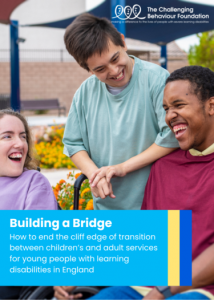
The Challenging Behaviour Foundation (CBF) have launched a new report, ‘Building a Bridge: How to end the cliff edge of transition between children’s and adult services for young people with learning disabilities in England’ bringing together family experiences with research about the issues with transition, and steps to address these. The report includes examples of how transitions can work successfully and five recommendations to improve experiences for people with learning disabilities and their families.

Transition to Adulthood – Challenging Behaviour Foundation

Health Inequalities Open Letter – Stronger Together

Can you support an open letter calling for government to prioritise the health of people with learning disabilities?

People with learning disabilities continue to experience significant health inequalities and poorer health outcomes.

A group of Learning Disability England members have come together to write an open letter to the Prime Minister setting out what needs to change so people can live longer, healthier lives. Some members will be personally delivering the letter to 10 Downing Street in July.

The letter calls on the Government to:

· Create a new national programme and strategy for people with learning disabilities
· Tackle health inequalities
· Keep everyone accountable for making change happen

We are asking you to consider signing the open letter, personally or on behalf of your organisation.
We hope as many people and organisations as possible will come together to champion the rights of people with learning disabilities and ensure they are seen, heard, and prioritised in health policy.

Easy read letter: https://www.learningdisabilityengland.org.uk/wp-content/uploads/2026/06/Open-letter-on-case-for-new-health-strategy-for-people-with-learning-disabilities.pdf

Sign the letter form: https://forms.office.com/pages/responsepage.aspx?id=b8cj-G6tqkW0weAyQU6wJUMUMxeyUhJDmpDax8AWRDJUMFZRTzFGVlE1RVUzTFBGWE85QVhZS1ZKUy4u&route=shorturl

#LearningDisabilityAwarenessWeek