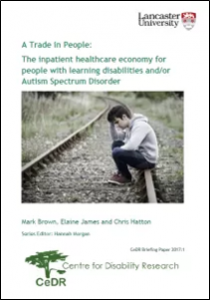
Download a copy: http://bit.ly/2srQ98K
Suicide rates among people with autism in England have reached “worryingly” high levels, according to an article in Lancet Psychiatry.
Writing ahead of a world-first international summit on suicidality in autism, the researchers – from Newcastle and Coventry universities – say the issue remains poorly understood and that action is urgently needed to help those most at risk.
Co-author Dr Jacqui Rodgers, from Newcastle University’s Institute of Neuroscience, said: “This unique event is of huge importance. For the first time researchers and clinicians from the fields of autism and suicide research will come together, along with members of the autism community and those bereaved by suicide, to learn from each other and identify clinical and research priorities to address this urgent issue.
Jon Spiers, chief executive of autism research charity Autistica, said: “For years society and the healthcare system have ignored the voices of families who have lost autistic loved ones unnecessarily, and far too young.
“Recent research revealing the sheer scale of the problem proves that we cannot let that continue.
“National and local government, research funders and industry, as well as the NHS and service providers all have a responsibility to tackle the issue of suicide in autism. Autistica is committed to playing a major part by funding mental health research programmes. This suicide summit will kick-start our campaign for change in this severely overlooked area.”
Coventry and Newcastle universities are running the international summit on suicide in autism – the first of its kind anywhere in the world – over the next two days, with funding from Autistica and the James Lind Alliance.
The aim is to develop recommendations for changes in government policy and practise that can be implemented quickly to reduce suicide in autism, and to decide on priorities for future research in the field.
East Kent Hospitals acknowledged the significant health inequalities that adults with learning disabilities experience in hospital; a Healthcare Passport was identified as a person centred and patient owned tool that contained pertinent personalised information enabling health care professionals to make adjustments for someone less able to communicate their needs and wishes. Led by East Kent Hospitals, a multi stakeholder group co-created a tool over a twelve month period and was awarded charitable funds to have the tool professionally designed and launched.
While stakeholders celebrated the launch of the tool at public event in 2012, new questions emerged as to the use of the passport and the improvements that adults with learning disabilities and their supporters could expect as a result of using it.
The aim of this participatory action research project was collaboratively identify, implement, evaluate and refine strategies enabling the passport to be used effectively in a person-centred way with people with learning disabilities, to achieve this aim, the following objectives were identified; to:
The Co-researcher team- made up of Nurses, people with learning disabilities, parent carers, and a care home manager – met 10 times over a twelve month period. Several key elements of data were collected:-
Underpinned by the critical creativity paradigm, practice development methodology and methods such as active learning, fourth generation evaluation and PATH were employed create the spirals of action research activity in a mixed ability co-researcher team.
The co-researcher team identified communities across the whole east Kent system to consult with either in person or via a web based survey. This sought to understand who had used the tool, the perceived benefits and improvements that could be made. The co-researcher team collectively analysed this data identifying themes, recommending and taking further action.
Non NHS staff experienced significant challenges relating to status and administration to be able to contribute. An example of this was the co-researchers with learning disabilities not having sufficient identification to achieve a clear Disclosure and Barring (DBS) check preventing them taking up full status as a Co-researcher.
The Co-researcher team consulted with approximately 420 stakeholders; through collective analysis three themes emerged:-
As a result,
Implications for practice
For further information check www.ekhuft.nhs.uk/passport and www.fons.org/library/report-details/71699

Information about the KSS LD COP Conference on 15 June in easy read available to download > #KSSCop17

STOMP – Stopping Over-Medication of People with a learning disability, autism, or both – now confirmed as speaker and running two workshops at the 15 June Conference: one for medical professionals and one for support providers. #KSSCOP2017
Download the booking form for the 15 June Conference, 9am to 4pm at The Charis Centre, Crawley, here: http://bit.ly/2r4m52x it’s a ‘fillable’ form – fill it in on the screen, save it and return it attached to an email to learning@bild.org.uk