Health Education England have published reports regarding learning disability liaison nursing. The full report, as well as appendices and easy-read version can be found below.
Category: learning disability
Research: Accessible Tourism for People with Disabilities
[Posted on behalf of Freya Rattenbury]
Hello!
We are a group of final year Surrey University students working on a consultancy project alongside Kent County Council with an aim to make countryside tourism accessible to the disabled market. We are therefore researching into the disabled market in aim to understand their accessibility needs. We also need to have a better understanding about the most effective marketing strategies for this audience. We are reaching out to you as charities in hope that you can aid us with our secondary research and would consider a short constructive interview regarding this market, marketing strategies, their needs and overall to help enable us to improve access to the Kent Countryside. If you would be happy to cooperate over an interview, please respond with a telephone number or appropriate email.
We have also constructed a market survey that we hope will give us a deeper understanding of our audience. The survey looks to gain an understanding of your past experiences when engaging with tourist destinations, where you would look for tourist destinations and how you feel about what is currently available to you.
It would be massively appreciated if you could share this survey with your contacts, directly to disabled people or carers, assisted living, residential or care home partners, and local charity branches.
Please click here for the market survey link.
We very much look forward to hearing back from you.
Learning Disabilities Job Vacancies
Three engaging roles have become available at Canterbury Christ Church University (2 vacancies) and St. Wilfred’s Hospice (1 vacancy). Please check the links below for more details about the roles and information on how to apply.
Part Time Lecturer/Senior Lecturer in Mental Health Nursing or Learning Disability Nursing
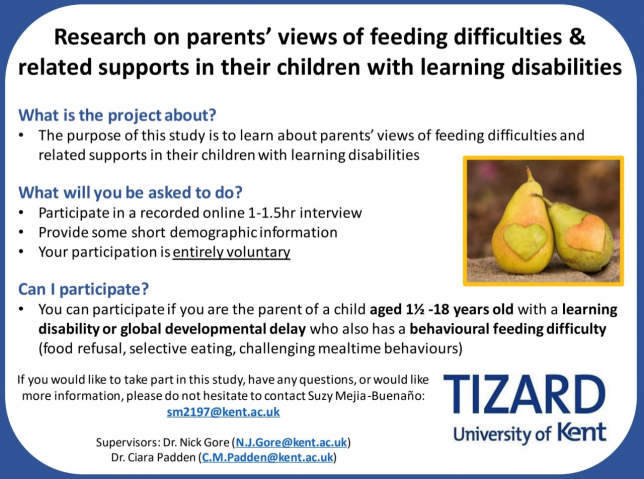
Research Call – Parents of Children with Learning Disabilities and Feeding Difficulties
Suzy Mejia-Buenano, a PhD student at the Tizard Centre, University of Kent is conducting a study exploring parents’ views of feeding difficulties and related supports in their children with learning disabilities. This study has been approved by Tizard Centre Ethics Committee and is being supervised by Dr. Nick Gore and Dr. Ciara Padden.
Taking part in this research will involve participating in a recorded, online 1-1.5 hour interview through Microsoft Teams with Suzy. You will also be asked to provide some short demographic information. All you need to take part is a mobile, tablet, laptop or computer with internet access. You do not need any apps or software; a link will be provided, and you will just have to click the link.
You can participate if your child is between the ages of 1.5 and 18 years, has a learning disability or global developmental delay, and a behavioural feeding difficulty (food refusal, selective eating, or challenging mealtime behaviours). Your participation is entirely voluntary.
If you or anyone you know is interested in participating, please do not hesitate to get in touch with Suzy (sm2197@kent.ac.uk) and we can have an initial discussion and provide an information sheet with more details about participating. Please feel free to share this research information widely.
Thank you in advance for your support and interest in this research.
Contact details: Suzy Mejia-Buenano (sm2197@kent.ac.uk)
UCL Stigma Research
“The UCL Unit for Stigma Research is conducting a study investigating how people with learning disabilities respond to being treated unfairly by others. We have developed a new measure to help understand this, the Responding to Intellectual Disability Stigma (RIDS) tool, and are looking for adults with mild to moderate learning disabilities to participate in a pilot study. This study has been designed from the outset with input from self-advocates with learning disabilities.
Taking part will involve a conversation supported with photographs by video call (via Skype, Zoom or Microsoft Teams, whichever the individual might be familiar with – support will be provided to access as necessary) with a researcher to discuss situations in which people with learning disabilities might be treated unfairly. Participants will also be asked questions relating to their well-being and self-esteem. We expect the video call will take up to an hour. To say thank you for their time contributing to this research, participants will be provided with information and resources to help them stand up for themselves when treated unfairly.
The RIDS study is being undertaken by Abigail Goldsmith-Sumner, a trainee clinical psychologist at UCL, as part of the wider Standing Up For Myself (STORM) project that the unit is running. If anyone in your organisation is interested, please pass on their information to Abigail, who will contact them for an initial discussion to explain the research in more detail and obtain informed consent. In addition, if you, your organisation, or a supporter/ family member would like more information, Abigail would also be happy to organise a phone or videocall to discuss.
Thank you for your support in advance. We hope this research will allow us to further understand the impact on individuals of experiencing stigma, and how interventions designed to improve the lives and wellbeing of people with learning disabilities may be of benefit.”
Contact details:
Twitter: @AbigailSumner2
