Mark Neary has a recurring nightmare.
He dreams that six months after his own death, his son Steven – who has autism and learning disabilities – will end up in a residential unit like the one in which he was once illegally held.
Mark Neary has a recurring nightmare.
He dreams that six months after his own death, his son Steven – who has autism and learning disabilities – will end up in a residential unit like the one in which he was once illegally held.
Health Education England working across Kent, Surrey and Sussex are offering funded places for the courses listed below.
Download: http://bit.ly/2tVo6iw
Email rhona.westrip@hee.nhs.uk to discuss making an application.
Following last year’s successful event we are delighted to be hosting the 2nd conference for occupational therapists working in diverse settings. Based on feedback from last year we have planned the day to share more examples from occupational therapists working in a range of exciting practice settings and provide time for more networking and sharing of ideas. We hope you can join us again.
Channine and Sarah
Date: Wednesday 6th September 2017.
Time: Coffee and networking from 9am and conference due to start 9.45-4.30pm
Venue: School of Health Sciences, University of Brighton, Eastbourne Robert Dodd campus, 49 Darley Road, Eastbourne, East Sussex, BN20 7UR.
Keynote speaker: Dr Jennifer Creek: Skills for a diverse practice of occupational therapy.The day will include opportunities for networking, presentations from occupational therapists working in a range of diverse practice settings, and a workshop on the new Career Development Framework with Dr Stephanie Tempest, Education Manager for Professional Development, Royal College of Occupational Therapists.
Cost: We want to keep the cost of the conference low again this year but would invite people to select the price that best reflects their employment earnings. • £35 for those earning less than £20,000 and anyone that is presenting at the conference. • £50 for those earning in range of £20-30,000 • £75 for academics attending on behalf of their University
There are 100 places so please book early to avoid disappointment. Closing date: Friday 25th August 2017
Contact details: C.Clarke@brighton.ac.uk 01273643771
Two one-hour webinar sessions on behaviour change theory for healthcare and public health professionals.
24 July and 31 July, 2pm – 3pm.
For further details or to book a place please email sarah.jewell@phe.gov.uk
#7DaysofAction 26th June – 2nd July 2017
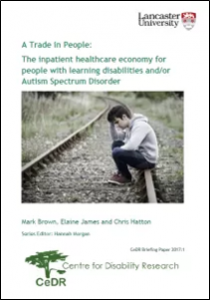
In support of the third 7 Days of Action, the Centre for Disability Research at Lancaster University is publishing ‘A Trade in People: The inpatient healthcare economy for people with learning disabilities and/or autism’.
Brown,M. James, E. and Hatton, C (2017) A Trade in People: The inpatient healthcare economy for people with learning disabilities and/or Autism Spectrum Disorder Lancaster: Centre for Disability Research [pdf].
A Trade in people Easy read version by Rebecca Fish [pdf]
